Deep Learning
MNIST with PyTorch + GradCAM
•4 min read
#deep learning
import torch
import torch.nn as nn
import torch.optim as optim
from torch.utils.data import DataLoader
import torchvision.transforms as transforms
import torchvision.datasets as datasets
# Define a transform to normalize the data
transform = transforms.Compose([
    transforms.ToTensor(),
    transforms.Normalize((0.5,), (0.5,))  # Normalize with mean=0.5, std=0.5
])

train_dataset = datasets.MNIST(root='./data', train=True, download=True, transform=transform)
test_dataset = datasets.MNIST(root='./data', train=False, download=True, transform=transform)

train_loader = DataLoader(dataset=train_dataset, batch_size=64, shuffle=True)
test_loader = DataLoader(dataset=test_dataset, batch_size=64, shuffle=False)
Build the model
class CNN(nn.Module):
    def __init__(self):
        super(CNN, self).__init__()
        self.conv1 = nn.Conv2d(1, 32, kernel_size=3, stride=1, padding=1)
        self.relu = nn.ReLU()
        self.pool = nn.MaxPool2d(kernel_size=2, stride=2)
        self.fc1 = nn.Linear(32 * 14 * 14, 10)  # 14x14 after pooling

    def forward(self, x):
        x = self.conv1(x)
        x = self.relu(x)
        x = self.pool(x)
        x = x.view(x.size(0), -1)  # Flatten the tensor
        x = self.fc1(x)
        return x

# Instantiate the model
model = CNN()
Assign Optimizer & Loss Function
criterion = nn.CrossEntropyLoss()
optimizer = optim.Adam(model.parameters(), lr=0.001)
Train the model
for epoch in range(1):  # One epoch
    for batch_idx, (data, target) in enumerate(train_loader):
        optimizer.zero_grad()  # Zero the gradients
        output = model(data)  # Forward pass
        loss = criterion(output, target)  # Compute loss
        loss.backward()  # Backward pass
        optimizer.step()  # Update weights

        if batch_idx % 100 == 0:
            print(f'Epoch: {epoch}, Batch: {batch_idx}, Loss: {loss.item()}')
Epoch: 0, Batch: 0, Loss: 2.2880163192749023

Epoch: 0, Batch: 100, Loss: 0.40903452038764954

Epoch: 0, Batch: 200, Loss: 0.2600383460521698

Epoch: 0, Batch: 300, Loss: 0.25161853432655334

Epoch: 0, Batch: 400, Loss: 0.18361416459083557

Epoch: 0, Batch: 500, Loss: 0.07740028202533722

Epoch: 0, Batch: 600, Loss: 0.15956029295921326

Epoch: 0, Batch: 700, Loss: 0.08738137781620026

Epoch: 0, Batch: 800, Loss: 0.10718843340873718

Epoch: 0, Batch: 900, Loss: 0.11650585383176804
model.eval()  # Set the model to evaluation mode
correct = 0
total = 0

with torch.no_grad():  # Disable gradient calculation for evaluation
    for data, target in test_loader:
        output = model(data)
        _, predicted = torch.max(output.data, 1)  # Get the predicted class
        total += target.size(0)
        correct += (predicted == target).sum().item()

print(f'Test Accuracy: {100 * correct / total:.2f}%')
Test Accuracy: 97.59%
# Save the model
torch.save(model.state_dict(), 'mnist_cnn.pth')

# Load the model
model = CNN()  # Recreate the model architecture
model.load_state_dict(torch.load('mnist_cnn.pth'))
model.eval()  # Set to evaluation mode
CNN(

  (conv1): Conv2d(1, 32, kernel_size=(3, 3), stride=(1, 1), padding=(1, 1))

  (relu): ReLU()

  (pool): MaxPool2d(kernel_size=2, stride=2, padding=0, dilation=1, ceil_mode=False)

  (fc1): Linear(in_features=6272, out_features=10, bias=True)

)
Visualize
import matplotlib.pyplot as plt
import numpy as np

# Set the model to evaluation mode
model.eval()

# Get a batch of test images
dataiter = iter(test_loader)
images, labels = next(dataiter)

# Make predictions
with torch.no_grad():
    outputs = model(images)
    _, predicted = torch.max(outputs, 1)

# Convert images to numpy arrays for visualization
images = images.numpy()

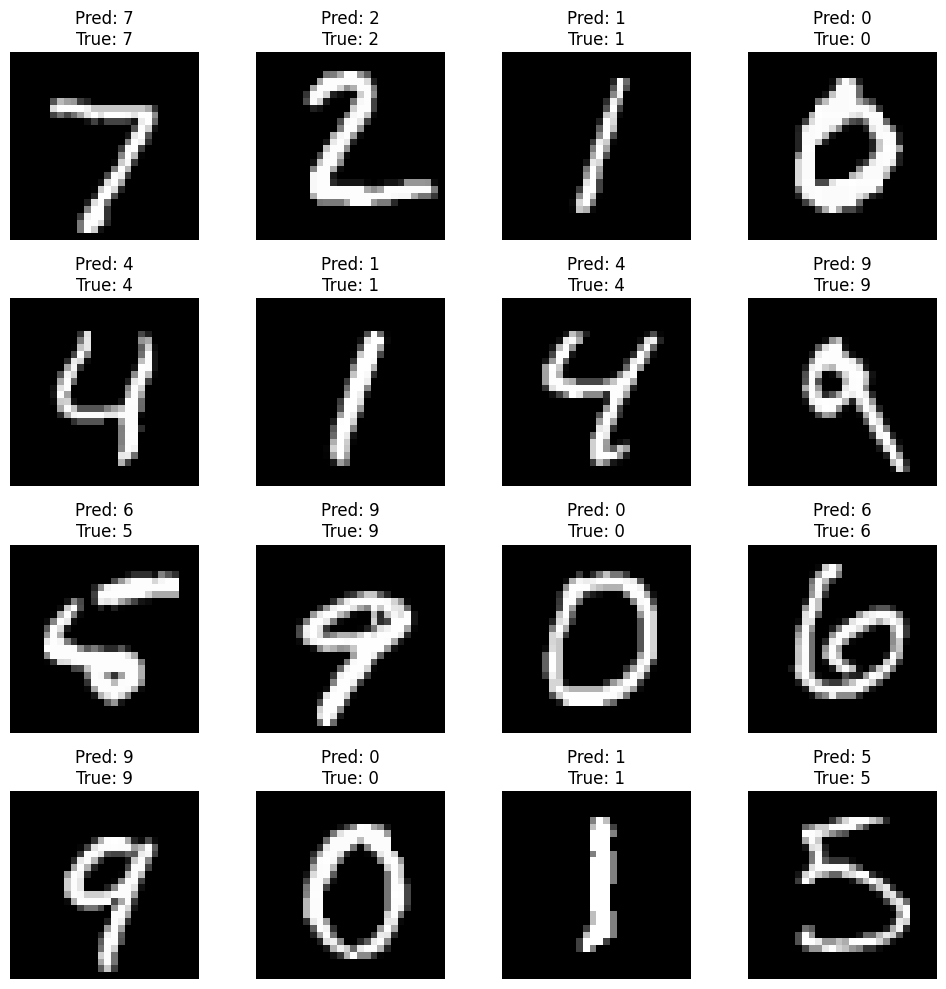
# Plot the images with their predicted and actual labels
fig, axes = plt.subplots(4, 4, figsize=(10, 10))
for idx, ax in enumerate(axes.ravel()):
    ax.imshow(np.squeeze(images[idx]), cmap='gray')
    ax.set_title(f'Pred: {predicted[idx].item()}\nTrue: {labels[idx].item()}')
    ax.axis('off')

plt.tight_layout()
plt.show()
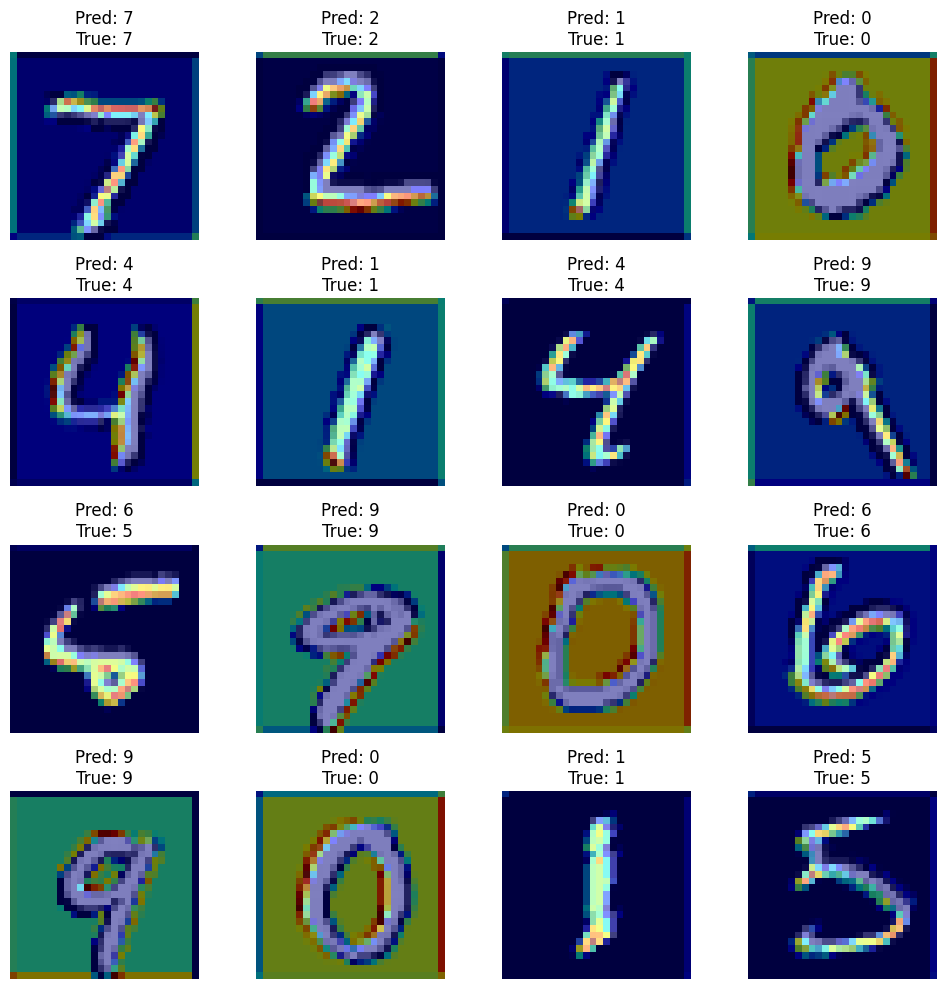
Adding Grad-CAM (Gradient-weighted Class Activation Mapping) is a great way to visualize which parts of an image the model is focusing on when making predictions. Grad-CAM highlights the regions of the image that were most influential in the model's decision.
To implement Grad-CAM in PyTorch, we need to:
-
Hook into the activations of the last convolutional layer.
-
Compute gradients of the target class with respect to those activations.
-
Combine the activations and gradients to produce the heatmap.
import torch.nn.functional as F

# Hook into the activations of the last convolutional layer
activations = None
def hook_fn(module, input, output):
    global activations
    activations = output

# Register the hook
model.conv1.register_forward_hook(hook_fn)

# Get a batch of test images
dataiter = iter(test_loader)
images, labels = next(dataiter)

# Forward pass
images.requires_grad_()  # Enable gradient computation for the input images
outputs = model(images)
_, predicted = torch.max(outputs, 1)

# Backward pass to get gradients
model.zero_grad()
loss = F.cross_entropy(outputs, labels)
loss.backward(retain_graph=True)  # Retain the graph for Grad-CAM computation

# Grad-CAM computation
grads = torch.autograd.grad(loss, activations, retain_graph=True)[0]  # Retain graph here as well
pooled_grads = grads.mean(dim=(2, 3), keepdim=True)
heatmap = (activations * pooled_grads).sum(dim=1, keepdim=True)
heatmap = F.relu(heatmap)  # Apply ReLU to the heatmap
heatmap /= heatmap.max()  # Normalize the heatmap

# Convert heatmap to numpy for visualization
heatmap = heatmap.squeeze().detach().numpy()

# Plot the original image and heatmap
fig, axes = plt.subplots(4, 4, figsize=(10, 10))
for idx, ax in enumerate(axes.ravel()):
    ax.imshow(np.squeeze(images[idx].detach().numpy()), cmap='gray')
    ax.imshow(heatmap[idx], cmap='jet', alpha=0.5)  # Overlay heatmap
    ax.set_title(f'Pred: {predicted[idx].item()}\nTrue: {labels[idx].item()}')
    ax.axis('off')

plt.tight_layout()
plt.show()